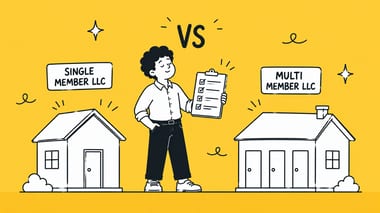
A Foreign-Owned Single Member LLC is a US limited liability company owned entirely by one non-US person, and in 2026, it remains one of the simplest ways for Sri Lankan entrepreneurs to run a US-facing business. You get access to Stripe, PayPal, and US banking, plus liability protection, without needing a visa, a Social Security number, or a single trip to the US. But the same “disregarded entity” status that makes it simple for income tax also comes with strict reporting duties, including Form 5472, BOI updates, and state-level filings, all carrying steep penalties if missed.
This guide walks through everything a Sri Lankan owner needs to know in 2026, from choosing a state and forming the LLC, to staying compliant year after year. Whether you’re setting one up for the first time or checking that your current LLC is still on track, you’ll find what you need below.
What Is a Foreign-Owned Single Member LLC?
A Foreign-Owned Single Member LLC is a US limited liability company that has only one owner, and that owner is not a US citizen or US resident. The owner can be an individual living in Sri Lanka or a foreign company. You don’t need a visa, a green card, or a Social Security number to form one or to own it fully.
By default, this type of LLC gets “disregarded entity” status from the IRS. This means the LLC itself is not treated as separate from its owner for federal income tax purposes. The company doesn’t file its own income tax return. Instead, its activity is reported as if it belongs directly to the owner.
Here’s how it compares to other LLC types:
| Feature | Foreign-Owned Single Member LLC | Foreign-Owned Multi-Member LLC | Regular US-Owned LLC |
| Owner residency | One non-US person or company | Two or more non-US persons or companies | US citizen or resident |
| SSN required | No | No | Usually yes |
| Tax filing | Form 5472 + pro forma 1120 required | Form 1065 partnership return + Schedule K-1s | Standard personal tax return |
| Income tax treatment | Disregarded, but reporting still required | Treated as a partnership by default | Disregarded, no extra reporting |
| IRS scrutiny | Higher, due to foreign ownership | Higher, due to foreign ownership | Lower |
Why Sri Lankan Entrepreneurs Choose a US LLC?
For many Sri Lankan founders, freelancers, and agency owners, a US LLC solves problems that are hard to fix locally. Here’s what makes it worth the paperwork:
- Access to US payment platforms. Stripe, PayPal, Mercury, and Wise all work far more smoothly with a US-registered business than with a Sri Lankan one. This makes it easier to invoice clients and receive USD payments without heavy conversion losses.
- More trust from international clients. A US LLC name and address on an invoice or website often carries more weight than a local business registration, especially with US or European clients.
- Simple legal protection. An LLC separates your personal assets from business liabilities, so a client dispute or debt doesn’t put your personal savings at risk.
- No need to relocate. You can form and run the LLC entirely from Sri Lanka. No visa, no US address, no in-person visit required for most setups.
- Straightforward structure. A single-member LLC has one owner, minimal paperwork, and no board or shareholder requirements, which keeps things simple to manage.
These benefits are exactly why the Foreign-Owned Single Member LLC has become the go-to structure for Sri Lankans doing business with US clients.
Is a Foreign-Owned LLC Legal for Sri Lankan Citizens?
Yes. Sri Lankan citizens can legally form and fully own a US LLC. US law places no restrictions on the nationality or residency of an LLC owner. You don’t need to be a US citizen, hold a green card, or carry a visa to start one.
You also don’t need a Social Security number. Non-residents can get an Employer Identification Number (EIN) instead, which the IRS issues specifically for this purpose. Ownership can be held by you as an individual, or by a Sri Lankan company if you’d rather form the LLC under a business entity.
There’s no requirement to live in the US, visit the US, or have a US mailing address in your own name. The only physical US presence you need is a registered agent, a person or service with a US address who receives legal and state notices on your behalf. This is a standard, low-cost part of forming any LLC.
Where things get serious is not the ownership itself. It’s the ongoing tax and reporting obligations that come with owning a Foreign-Owned Single Member LLC.
Things You Need to Know Before Choosing the Right State to Form Your LLC
Not every state works the same way for a Foreign-Owned Single Member LLC. Before you pick one, weigh these factors:
- Filing fees and annual costs. Each state charges different amounts to form an LLC and keep it active. Some also require annual reports or franchise taxes on top of the initial fee.
- State income tax. A few states charge no state income tax, which matters if your LLC has US-source income. Others do, even if you don’t live there.
- Privacy protections. Some states don’t publish owner names in public records, which keeps your ownership details private.
- Legal system and court reputation. States with well-established business courts offer more predictable outcomes if a dispute ever comes up.
- Where your business actually operates. If you plan to work with clients or vendors tied to a specific state, forming there may simplify registration and taxes.
Most Sri Lankan founders don’t need a physical presence in any particular state, so the decision usually comes down to cost, privacy, and tax treatment rather than location. The next section compares the most popular choices side by side.
Step-by-Step Single Member LLC Formation Process
Forming a Foreign-Owned Single Member LLC follows a clear sequence. Here’s how it works from start to finish:
- Pick a business name. Choose a name that’s available in your chosen state and follows its naming rules, usually including “LLC” or “Limited Liability Company” at the end.
- Appoint a registered agent. This is a person or service with a physical address in the state, who receives legal documents and state notices on your behalf. You can’t use a foreign address for this role.
- File the Articles of Organization. This document officially creates your LLC with the state. It includes basic details like the business name, address, and registered agent information.
- Create an operating agreement. Not every state requires this, but it’s worth having. It sets out how the LLC is owned and run, which helps if a bank or client ever asks for proof of structure.
- Apply for an EIN. The IRS issues this number without requiring a Social Security number. Non-residents typically apply by fax or phone rather than online.
- Open a US business bank account. Many digital banks now serve non-residents remotely, so an in-person visit usually isn’t necessary.
- Keep up with state compliance. File annual reports and pay any required fees to keep the LLC in good standing.
Once these steps are done, your LLC is ready to operate, though tax and reporting duties start right away.
How the IRS Taxes a Foreign-Owned Single Member LLC
By default, a Foreign-Owned Single Member LLC is a disregarded entity for federal income tax purposes. This means the LLC itself doesn’t pay income tax or file a separate tax return. Its activity flows through to you, the owner.
But “disregarded” only applies to income tax. For reporting purposes, the IRS treats the LLC as if it were a domestic corporation. This is why you still have separate filing duties, even with zero income tax owed.
Does Your Income Actually Get Taxed?
Whether you owe US tax at all depends on where the income comes from and how it’s earned. Foreign-source income earned by a nonresident owner, with no US trade or business, is generally not subject to US federal income tax.
Income tied to a US trade or business is different. This is called effectively connected income (ECI), and it is taxable in the US.
Common triggers include:
- Having employees or a dependent agent in the US
- Running a business that requires a physical US presence
Most online service businesses run from Sri Lanka avoid ECI. But the details matter enough to check with a tax professional before assuming you owe nothing.
Form 5472 and Form 1120 Filing Requirements
Every Foreign-Owned Single Member LLC must file Form 5472 each year, even if the business made no money. This form reports transactions between the LLC and its foreign owner, and the IRS uses it to track money moving in and out of the US.
You don’t file Form 5472 on its own. It must be attached to a pro forma Form 1120, a corporate tax form that you fill out only partially. You’re not reporting income here, just providing the cover sheet the IRS needs to process the 5472. Across the top of this Form 1120, you must write “Foreign-owned U.S. DE.”
A “reportable transaction” covers more than sales. It includes capital contributions, distributions, loans, and even paying LLC formation costs from your personal account. If any of these happened during the year, you need to file.
For calendar-year filers, the deadline is April 15. Filing Form 7004 extends it to October 15. These forms can’t be e-filed. You must mail or fax them to a specific IRS address in Ogden, Utah.
Missing the deadline, or filing an incomplete form, carries a $25,000 penalty. If the IRS notifies you and the issue isn’t fixed, another $25,000 gets added every 30 days after that.
Given the stakes, this is one filing worth getting right the first time, even with a $0 income LLC.
Want to understand every penalty tied to a missed or incorrect Form 5472?
BOI Reporting and FinCEN Rules in 2026
Beneficial Ownership Information (BOI) reporting has changed significantly since the Corporate Transparency Act first took effect. Here’s where things stand for a Foreign-Owned Single Member LLC in 2026:
- US-formed entities are exempt. Under FinCEN’s interim final rule from March 2025, entities created in the United States, along with their beneficial owners, no longer have to file BOI reports. This covers most Foreign-Owned Single Member LLCs, since they’re typically formed in states like Wyoming or Delaware.
- Foreign-formed entities still may need to file. If your business was formed outside the US and then registered to do business in a US state, it’s still classified as a “reporting company” and BOI filing obligations likely still apply.
- The underlying law hasn’t been repealed. The Corporate Transparency Act remains in effect. The current exemption comes from FinCEN’s rule-making, not a change in the law itself, which means future rulings could bring reporting requirements back for domestic entities too.
Because of this, don’t treat the exemption as permanent. Check FinCEN’s current guidance before assuming you have no BOI obligation, especially if your filing situation involves anything other than a simple, single-state, US-formed LLC. A quick review each year takes far less effort than a missed filing later.
FBAR and Foreign Account Reporting
If your Foreign-Owned Single Member LLC holds money outside the US, or you have signing authority over foreign accounts tied to the business, you may need to file an FBAR (Report of Foreign Bank and Financial Accounts).
When You Need to File
You must file an FBAR if the combined value of all your foreign financial accounts went over $10,000 at any point during the year. This includes:
- Business bank accounts held outside the US
- Personal accounts you use to receive or hold LLC funds
- Any account where you have signature authority, even if you’re not the account holder
The $10,000 threshold applies to the total across all accounts, not each account separately. So three accounts with $4,000 each still trigger the filing requirement.
Deadlines and How to File
FBAR is due April 15, with an automatic extension to October 15. You don’t need to request the extension separately; it’s built in. Filing is done electronically through FinCEN’s BSA E-Filing System, separate from your IRS tax filings.
Penalties for Not Filing
Missing an FBAR filing carries real consequences. Non-willful violations can still result in penalties, and willful violations are far more serious, sometimes reaching into tens of thousands of dollars or a percentage of the account balance.
If most of your LLC’s banking happens through a US-based account, this may not apply to you. But if you’re moving money through Sri Lankan accounts too, it’s worth checking each year.
US-Sri Lanka Tax Treaty Considerations
The US and Sri Lanka do have an income tax treaty, in force since 2004. It’s designed to prevent double taxation and reduce withholding rates on certain cross-border income between the two countries.
What the Treaty Can Do for You
- Reduce withholding tax on qualifying income, instead of the default 30% rate the IRS applies to non-treaty countries
- Provide relief through foreign tax credits, so tax paid in one country can offset tax owed in the other
- Set clearer rules for how business profits, dividends, and certain other income types get taxed across borders
How to Claim Treaty Benefits
Treaty benefits aren’t automatic. You typically need to file the right disclosure form with the IRS to claim a reduced rate or exemption. Skipping this step means the IRS defaults to standard non-treaty withholding, even if the treaty would have applied.
ITIN vs EIN
These serve different purposes, and mixing them up is a common mistake. Your LLC uses an EIN for its own reporting. You, as the owner, may need an ITIN if you’re filing a personal US return or claiming treaty benefits directly.
| Feature | EIN | ITIN |
| Who it’s for | The LLC (the business itself) | You, the individual owner |
| Purpose | Business tax reporting, bank accounts, Form 5472/1120 | Personal tax filing, claiming treaty benefits |
| Issued by | IRS, via Form SS-4 | IRS, via Form W-7 |
| SSN required | No | No |
| When you need it | As soon as you form the LLC | Only if you file a personal return or claim treaty benefits directly |
Since treaty rules depend heavily on your specific income type and situation, it’s worth confirming your exact position with a tax professional rather than assuming the treaty automatically applies.
Common Compliance Mistakes to Avoid
Most compliance problems with a Foreign-Owned Single Member LLC come from a handful of repeated mistakes. Watch out for these:
- Assuming no income means no filing. Form 5472 is required even at $0 income, as long as a reportable transaction happened, including simply paying formation costs from your own pocket.
- Missing the Form 5472 deadline. The penalty starts at $25,000 and climbs from there if the issue isn’t fixed after an IRS notice.
- Mixing personal and business funds. Using one account for both personal and LLC expenses makes it harder to prove liability protection and complicates transaction reporting.
- Ignoring state annual report requirements. States can dissolve an LLC that falls out of compliance, even if federal taxes are handled correctly.
- Assuming BOI rules never apply. US-formed entities are currently exempt, but this depends on FinCEN’s current rule, not a permanent law change.
- Skipping FBAR when foreign accounts are involved. Any account tied to the business, personal or otherwise, counts toward the $10,000 threshold.
- Filing Form 1120 incorrectly. A pro forma 1120 without the “Foreign-owned U.S. DE” label attached can create processing delays.
Getting ahead of these mistakes early is far cheaper than fixing them after the IRS notices.
For a complete checklist of every annual obligation your LLC carries, read our US LLC annual compliance guide for Sri Lankans.
Costs of Running a Foreign-Owned LLC From Sri Lanka
Running a Foreign-Owned Single Member LLC involves more than the initial filing fee. Here’s a realistic breakdown of what to budget for:
- State filing fee. Ranges from $50 to $300 depending on the state, with Wyoming ($100), Delaware ($90), and New Mexico ($50) among the most popular for foreign owners.
- Registered agent. Expect $50 to $300 per year for a service to maintain your required US address.
- EIN application. Free if you apply directly through the IRS, though some formation services charge a fee to handle it for you.
- Annual state fees. These vary widely. Wyoming charges around $60 a year, Delaware charges a flat $300 franchise tax, and New Mexico currently has no annual report requirement at all.
- Tax filing and accounting. Form 5472 and the pro forma Form 1120 are complex enough that most owners hire a tax preparer, which typically costs more than the state fees combined.
- Business bank account. Often free to open, though some digital banks charge monthly fees for international account holders.
The state filing fee is usually the smallest cost on the list. Annual fees and professional tax help make up the bulk of what you’ll actually spend each year, so factor those in before picking a state.
For a detailed year-by-year cost breakdown, read our US LLC cost guide for non-residents.
Let BR.LK Handle the Compliance, So You Can Focus on Growth
Running a Foreign-Owned Single Member LLC comes with real deadlines and real penalties, from Form 5472 to BOI reports to annual state filings. Missing even one of these can cost you far more than the price of doing it right the first time.
BR.LK helps Sri Lankan founders form and maintain their US LLC without the guesswork. Our team handles registered agent service, EIN and ITIN applications, BOI reporting, annual reports, bookkeeping, and US bank account setup, all with support in Sinhala and Tamil, so nothing gets lost in translation.
Prefer a quick chat instead?
Message us on WhatsApp at +94 77 789 5327and we’ll walk you through your options.
Conclusion
A Foreign-Owned Single Member LLC gives Sri Lankan entrepreneurs a simple, low-cost way to run a US-facing business without relocating, hiring a lawyer for every step, or holding a US passport. The formation part is genuinely easy. Name your company, appoint a registered agent, file your paperwork, and get an EIN.
The part that trips people up is what comes after. Form 5472, the pro forma Form 1120, BOI updates, FBAR, and state annual reports all carry their own rules and deadlines, and a few of them apply even when your LLC made no money. None of this makes a US LLC a bad choice. It just means the ownership is the easy 10%, and the compliance is the 90% that actually protects your business.
If you’re forming your first LLC in 2026, build a simple calendar for these deadlines from day one. If you already have one running, take a few minutes to check each requirement against your current setup. A missed filing is far more expensive to fix than it is to prevent.
Get the compliance right, and a Foreign-Owned Single Member LLC can serve your business well for years without any surprises from the IRS.
Key Takeaways
- A Foreign-Owned Single Member LLC is a US LLC owned entirely by one non-US person, and it doesn’t require a visa, green card, or Social Security number to form.
- The LLC gets “disregarded entity” status by default, so it doesn’t pay federal income tax or file its own income tax return.
- Disregarded status only applies to income tax, not to reporting, so the IRS still treats the LLC as a domestic corporation for filing purposes.
- Every Foreign-Owned Single Member LLC must file Form 5472 with a pro forma Form 1120 each year, even with zero income, as long as a reportable transaction occurred.
- Missing or filing an incomplete Form 5472 carries a $25,000 penalty, with another $25,000 added every 30 days after an IRS notice.
- Most US-formed LLCs are currently exempt from BOI reporting under FinCEN’s 2025 rule, but this exemption isn’t guaranteed to stay permanent.
- An FBAR filing is required if the combined value of all foreign financial accounts tied to the LLC exceeds $10,000 at any point in the year.
- The US-Sri Lanka tax treaty, in force since 2004, can reduce withholding tax and prevent double taxation, but benefits must be actively claimed, not assumed.
- An EIN is for the LLC itself, while an ITIN is for the individual owner filing a personal US return or claiming treaty benefits.
- Ongoing costs like registered agent fees, annual state reports, and tax preparation usually add up to more than the initial state filing fee, so budget for the full year, not just formation.
FAQs
Yes, a single-member LLC can be formed and run entirely from Sri Lanka. You don’t need a US address, visa, or in-person visit. The only US presence required is a registered agent, who receives legal and state notices on your behalf while you manage the business remotely.
No. Several digital banks, including Mercury and Wise, let non-resident LLC owners open a US business bank account fully online. Traditional banks sometimes require an in-person visit, so check each provider’s requirements before applying if remote access matters to you.
Even with zero income, a foreign-owned single-member LLC may still need to file Form 5472 if any reportable transaction occurred, such as paying formation costs personally. With truly no transactions, filing requirements can differ, so confirm your exact situation with a tax professional.
Yes. You can file Form 8832 with the IRS to elect corporate tax treatment, or convert the legal entity through your state. Many founders start with a single-member LLC for its simplicity, then convert once the business grows or outside investors require a corporate structure.
Yes. A US LLC doesn’t remove your Sri Lankan tax obligations. Sri Lankan tax residents generally still report worldwide income locally, including income earned through a foreign LLC. Confirm exact reporting rules with a Sri Lankan tax advisor to stay compliant on both sides.
A single-member LLC owner typically pays themselves through an owner’s draw, transferring funds from the business account to a personal account as needed. There’s no formal payroll, since the LLC is a disregarded entity and its profits are already taxed as the owner’s personal income.
A single-member LLC is simpler, with fewer filing requirements and lower running costs. An S corp can reduce self-employment tax at higher profit levels but adds payroll and stricter compliance. Most foreign-owned businesses start with an LLC, then evaluate S corp election once income grows.