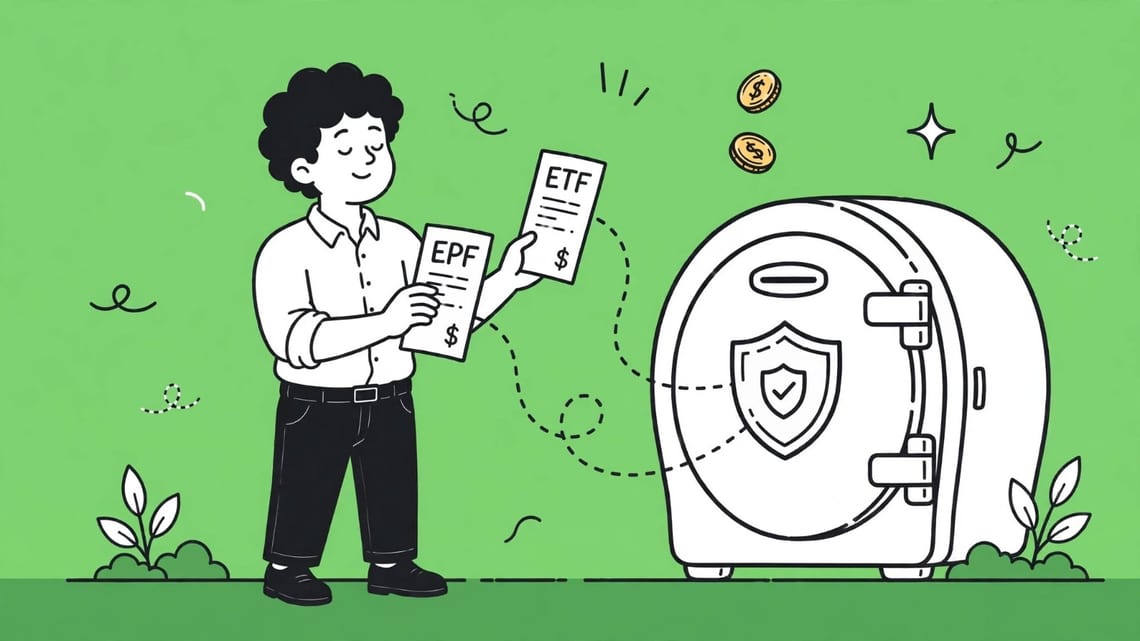
Employers in Sri Lanka must pay two contributions on every employee’s monthly earnings. The first is 12% into the Employees’ Provident Fund (EPF). The second is 3% into the Employees’ Trust Fund (ETF). Together, this is a 15% cost on top of salary. Employees also pay 8% into EPF, which the employer deducts from their pay. Both contributions are due by the last working day of the following month, and late payment leads to surcharges.
If you run a business or handle payroll, getting EPF and ETF right saves you money and trouble. This guide explains what each fund is, who must pay, how to calculate it, and when to pay. You will also find a worked example, a checklist and the common mistakes to avoid. Read on to see how EPF and ETF Sri Lanka rules apply to your business.
What Are EPF and ETF in Sri Lanka?
EPF and ETF are the two main statutory funds for private-sector and semi-government employees in Sri Lanka. Every covered employer must pay into both funds each month.
- Employees’ Provident Fund (EPF): A compulsory retirement savings fund set up under the Employees’ Provident Fund Act No. 15 of 1958. Both the employer and the employee contribute. The Monetary Board of the Central Bank of Sri Lanka manages the fund, and the Department of Labour handles employer registration and enforcement. Members receive their savings plus interest as a lump sum when they retire.
- Employees’ Trust Fund (ETF): A fund set up under the Employees’ Trust Fund Act No. 46 of 1980 and managed by the Employees’ Trust Fund Board. Only the employer contributes, so it costs the employee nothing. Members can withdraw their balance when they retire or leave covered employment. The fund also offers some welfare benefits to members.
Together, EPF and ETF give employees a financial safety net. For employers, they are a fixed monthly payroll cost.
Main Differences Between EPF and ETF
| Feature | EPF | ETF |
| Governing law | EPF Act No. 15 of 1958 | ETF Act No. 46 of 1980 |
| Managed by | Central Bank of Sri Lanka | ETF Board |
| Employer contribution | 12% | 3% |
| Employee contribution | 8% | None |
| Total contribution | 20% | 3% |
| Main purpose | Retirement savings | Savings plus member welfare benefits |
| Paid to member | At retirement | At retirement or on leaving covered employment |
Which Employers Must Pay EPF and ETF?
Any employer in the private sector or the semi-government sector must pay EPF and ETF for their employees. This includes companies, partnerships, sole proprietors, NGOs, statutory boards and state corporations whose staff are not covered by the government pension scheme. The rule applies regardless of business size, so an employer with even one employee must register and contribute.
Contributions apply to most types of employees, including:
- Permanent employees
- Employees on probation
- Casual, temporary and contract employees
- Part-time employees
- Employees paid daily, weekly or by piece rate
Some groups are not covered. Government employees who are entitled to a state pension do not join EPF or ETF. Household employees, such as domestic workers, are currently not required to be covered by EPF.
Once a business hires its first employee, it should register with the Department of Labour for EPF and with the ETF Board for ETF. After registration, the employer receives an employer number, which it must use for all contributions and returns.
EPF and ETF Contribution Rates for Employers
Employers in Sri Lanka pay contributions to two funds each month. The rates are set by law and apply to the employee’s total monthly earnings.
- EPF – employer share (12%): The employer pays 12% of the employee’s total earnings into EPF. This is an extra cost on top of the salary and must not be deducted from the employee’s pay.
- EPF – employee share (8%): The employee contributes 8% of total earnings. The employer deducts this from the salary and sends it to EPF together with the employer’s 12%.
- ETF – employer share (3%): The employer pays 3% of total earnings into ETF.
- Employees do not contribute to ETF.
These are minimum rates, and neither fund has a salary cap. Contributions apply to the full earnings amount, however high the salary.
| Contribution | Paid by | Rate |
| EPF | Employer | 12% |
| EPF | Employee (deducted from salary) | 8% |
| ETF | Employer | 3% |
| Total employer cost | Employer | 15% |
| Total paid into both funds | Employer + Employee | 23% |
What Counts as “Total Earnings” for EPF and ETF?
For EPF and ETF purposes, “total earnings” means more than basic salary. Contributions must be calculated on the full amount the employee earns for their normal work, including most regular allowances.
| Usually Included | Usually Excluded |
| Basic salary or wages | Overtime pay |
| Cost of living allowance | Bonus and incentive payments |
| Special living allowance and other fixed allowances paid regularly | Travelling allowance and expense reimbursements |
| Meal allowance | Gratuity |
| Holiday pay (pay for leave days) | |
| Cash value of food provided by the employer |
A simple test helps here. If an allowance is fixed and paid every month as part of the employee’s normal pay, it should usually be included. If a payment is occasional or covers a business expense, it is usually excluded.
Many employers get this wrong by calculating EPF and ETF on basic salary only. This leads to underpayment, which can bring surcharges and back payments later. If you are unsure about a specific allowance, check with the Department of Labour before running payroll.
How to Calculate EPF and ETF (With Example)
Calculating EPF and ETF takes a few simple steps. Use the employee’s total earnings for the month as the base.
Steps to calculate:
- Add up the employee’s total earnings for the month (basic salary plus included allowances).
- Multiply by 12% to get the employer’s EPF share.
- Multiply by 8% to get the employee’s EPF share.
- Multiply by 3% to get the employer’s ETF share.
- Add the employer’s EPF and ETF shares to find your total cost.
Example:
An employee earns LKR 80,000 basic salary plus LKR 20,000 in fixed allowances. Total earnings are LKR 100,000.
| Item | Calculation | Amount (LKR) |
| Employer EPF (12%) | 100,000 × 12% | 12,000 |
| Employee EPF (8%) | 100,000 × 8% | 8,000 |
| Employer ETF (3%) | 100,000 × 3% | 3,000 |
| Total employer cost | 12,000 + 3,000 | 15,000 |
| Total EPF payment | 12,000 + 8,000 | 20,000 |
In this example, the employer deducts LKR 8,000 from the employee’s salary. The employee receives LKR 92,000 before any tax. The employer then pays LKR 20,000 to EPF and LKR 3,000 to ETF.
How Employers Pay EPF and ETF
Employers pay EPF and ETF separately, because each fund has its own system and its own payment channels.
Paying EPF
- Register with the Department of Labour and get an employer number.
- Prepare the monthly contribution details for each employee, including member numbers and total earnings.
- Send the full amount (employer 12% plus employee 8%) to the EPF Department of the Central Bank.
Employers can use the EPF online payment system through participating banks. Direct debit is also available, but only for employers with at least 50 employees. Each payment must be matched with the monthly return (Form C).
Paying ETF
- Register with the ETF Board and get an ETF employer number.
- Calculate 3% of each employee’s total earnings.
- Pay the contribution electronically and submit the monthly return.
The ETF Board requires electronic payment and electronic submission of returns, so paper-based payments are no longer accepted. Keep the payment receipt as proof.
Good to Know:Use the correct employer number and member numbers for every payment. Errors can cause the money to be credited to the wrong account or delay the update of member balances.
EPF and ETF Payment Deadlines
Employers must pay EPF and ETF contributions by the last working day of the following month. For example, contributions for October salaries must reach the funds by the last working day of November.
This deadline applies to both funds. It is different from the APIT deadline, which falls on the 15th of the following month, so keep the two dates separate in your payroll calendar.
| Salary Month | EPF and ETF Due Date |
| October 2026 | Last working day of November 2026 |
| November 2026 | Last working day of December 2026 |
| December 2026 | Last working day of January 2027 |
Things to remember:
- The due date is the day the payment reaches the fund, not the day you start the payment. Pay a few days early to allow for bank delays.
- If the last day of the month is a weekend or public holiday, pay on the last working day before it.
- Monthly returns must be submitted along with the payment.
- Paying late, even by a few days, can lead to a surcharge.
A simple habit is to set a payroll reminder for the 20th of every month. This gives you enough time to check the figures and pay before the deadline.
Penalties for Late or Unpaid Contributions
Employers who pay late, pay less than required, or do not pay at all face financial penalties and possible legal action.
Surcharges on late payment
- EPF: A surcharge is added based on how many days the payment is late. When the amount paid is less than the amount due, a surcharge applies to the shortfall until it is paid in full.
- ETF: Section 27 of the ETF Act sets a surcharge on late contributions. Section 37A sets a separate surcharge on late monthly returns.
Other consequences
| Issue | What can happen |
| Late payment | Surcharge on top of the contribution |
| Underpayment (for example, using basic salary only) | Back payment plus surcharge on the shortfall |
| Late or missing returns | Separate surcharge under the ETF Act |
| Non-payment | Letters of demand and legal action by the Department of Labour |
Surcharge notices must be paid with the late contribution. Surcharge payments also need the notice number when paid to the ETF Board.
The cheapest way to avoid penalties is to pay on time and calculate on total earnings, not basic salary alone.
Employer Responsibilities Checklist
Once you register as an employer, a few tasks repeat every month. Use this checklist to stay compliant.
| Responsibility | What to Do | When |
| Register as an employer | Register with the Department of Labour (EPF) and the ETF Board (ETF) and keep both employer numbers | When you hire your first employee |
| Register new employees | Collect each employee’s NIC and personal details and add them to your EPF and ETF returns | When each employee joins |
| Calculate on total earnings | Include basic salary and regular allowances, not basic salary alone | Every month |
| Deduct the employee’s 8% | Deduct it from salary and do not pay it from company funds | Every payroll run |
| Pay on time | Pay EPF and ETF by the last working day of the following month | Every month |
| Submit monthly returns | File the returns together with each payment | Every month |
| Keep records | Store payslips, payment receipts and returns | Ongoing |
| Update member details | Correct name, NIC or member number errors quickly | When changes occur |
| Share details with employees | Show EPF and ETF amounts on payslips | Every payslip |
| Settle surcharges | Pay any surcharge notices along with the late contribution | When notified |
Review the list at the end of each payroll month. It takes only a few minutes and helps you avoid surcharges.
Common Employer Mistakes to Avoid
Most EPF and ETF problems come from a few repeated errors. Check your payroll process against this list.
| Mistake | Why It Is a Problem | How to Avoid It |
| Calculating on basic salary only | Leads to underpayment, back payments and surcharges | Include all regular allowances in total earnings |
| Paying after the deadline | Adds a surcharge on top of the contribution | Pay a few days before the last working day of the month |
| Missing new employees | Staff go without contributions, and you owe the arrears later | Add each employee to the returns from their first month |
| Wrong member numbers or NIC details | Money may be credited to the wrong account or delayed | Check details when the employee joins and before each payment |
| Paying the employer share from the employee’s salary | The employer’s 12% and 3% must be an extra cost to the company | Deduct only the employee’s 8% from pay |
| Deducting 8% but not paying it | The employee loses savings, and the employer faces legal action | Send the full amount to the fund every month |
| Skipping monthly returns | Brings a separate surcharge, especially under the ETF Act | File the return with every payment |
| Mixing up the EPF and ETF payment channels | Payments may not reach the right fund | Pay each fund through its own system |
Most of these mistakes are easy to catch with a monthly review before payment.
EPF and ETF vs Other Payroll Obligations
EPF and ETF are only part of what an employer handles each month. Two other obligations sit alongside them:
- APIT (income tax deducted from pay)
- Gratuity (a payment made when an employee leaves).
The table below shows how these four obligations compare, so you can see who pays, who receives the money and when each one is due.
| Feature | EPF | ETF | APIT | Gratuity |
| Purpose | Retirement savings | Savings and welfare benefits | Income tax on employment income | Reward for long service |
| Who pays | Employer 12% and employee 8% | Employer 3% | Employee, deducted by employer | Employer |
| Paid to | Central Bank (EPF) | ETF Board | Inland Revenue Department | Employee |
| When | Monthly | Monthly | Monthly | When employment ends |
| Due date | Last working day of next month | Last working day of next month | 15th of next month | Within 30 days of leaving |
APIT is taken from the employee’s pay, so it does not add to employer cost. Since April 2025, the first LKR 150,000 of monthly income is tax-free, and higher income is taxed in bands from 6% to 36%.
Gratuity applies to employees with at least five years of service. It is usually half a month’s salary for each completed year, so employers should set aside a small amount every month.
Ready to Hire Staff? Set Up Your Business the Right Way
EPF and ETF are monthly costs, so it helps to know your numbers before you hire. Use our free EPF / ETF Calculator to check what each employee will cost you, and our Payroll Studio to run salaries.
If you are still trading as an individual and plan to hire, a registered private limited company is the cleaner way to start. It gives you a proper legal structure, a company bank account and a TIN, which are the things you need in place before you take on employees.
At BR.LK, we register Sri Lankan private limited companies in 3 to 5 days, fully online. Prices start from Rs. 34,900, with Registrar of Companies fees and stamp duty included, so nothing is added later.
Not sure which package fits? Talk to our team first.
Conclusion
EPF and ETF are fixed monthly costs for every employer in Sri Lanka. You pay 12% into EPF and 3% into ETF on each employee’s total earnings, and you deduct a further 8% from their pay for EPF. Both payments are due by the last working day of the following month, and each fund has its own payment channel and monthly return.
Most problems come from the same few errors: using basic salary only, paying late, or missing a new employee. A short monthly check before payment prevents most of them and helps you avoid surcharges.
Keep your payroll calendar, records and calculations in order, and EPF and ETF in Sri Lanka will stay a simple routine.
Key Takeaways
- EPF and ETF are two separate statutory funds, and every private-sector and semi-government employer in Sri Lanka must pay into both.
- Employers pay 12% of each employee’s total earnings into EPF and 3% into ETF, which is a 15% cost on top of salary.
- Employees pay 8% into EPF, and the employer deducts it from their salary before sending it to the fund.
- Only the employer pays into ETF, so employees pay nothing toward it.
- Neither fund has a salary cap, so contributions apply to the full earnings amount.
- Total earnings include basic salary and regular fixed allowances, so calculating on basic salary alone leads to underpayment.
- Employers must register with the Department of Labour for EPF and with the ETF Board for ETF as soon as they hire their first employee.
- EPF and ETF are due by the last working day of the following month, which is later than the APIT deadline on the 15th.
- Late or short payments bring surcharges, and non-payment can lead to letters of demand and legal action.
- A monthly review of calculations, member details, payments and returns is the easiest way to avoid the most common employer mistakes.
FAQs
No. Neither fund has a salary ceiling. Employers pay 12% EPF and 3% ETF on the employee’s full total earnings, however high the salary. The employee’s 8% EPF share also applies to the full amount.
Yes, but only by choice. 12% is the minimum the law requires. An employer can agree to pay a higher rate through a contract or company policy, but it is not compulsory. Confirm the process with the EPF Department before paying more.
Yes. EPF and ETF apply to part-time employees and staff on probation, as well as permanent, casual, temporary and contract workers. Work pattern does not matter. Each employee’s total earnings are the base for both contributions.
Yes. Employers can pay late EPF contributions directly to the EPF Department of the Central Bank, together with the surcharge set by the Department of Labour. For ETF, pay the late contribution and surcharge to the ETF Board and enter the surcharge notice number.