A foreign-owned multi member LLC is a US limited liability company with two or more owners who live outside the US. Sri Lankans can form one without US residency, a Social Security Number, or a trip to the US. The LLC protects your personal assets, passes profit to the members, and gives you access to Stripe, US banks, and USD payments. It also brings US tax filings, state fees, and Sri Lankan tax rules that you must handle every year.
This guide covers everything Sri Lankan partners need to know in 2026. You will learn how a multi member LLC works, which state to pick, how to form one step by step, how it is taxed in the US and Sri Lanka, what it costs, and which mistakes to avoid. If you plan to start a business with partners, read on and set it up the right way from day one.
What Is a Multi Member LLC?
A multi member LLC is a limited liability company with two or more owners. The owners are called members. A member can be a person or another company.
The LLC is a separate legal entity. This means the business, not the owners, is responsible for its debts and contracts. Your personal assets, such as your home or savings, are usually safe if the business is sued or owes money.
By default, the IRS treats a multi member LLC as a partnership. The LLC does not pay income tax itself. Profit and loss pass through to the members, and each member reports their share on their own tax return.
Members decide how to split ownership, profit, and voting rights in a written operating agreement. This makes the structure a common choice for business partners, family members, and freelancers who work together.
Can Sri Lankans Own a Multi Member LLC in the US?
Yes. The US does not require LLC owners to be citizens or residents. Two or more Sri Lankans can form and own a multi member LLC together. Members can also be a mix of Sri Lankans and people from other countries, or even companies.
You do not need to live in the US or visit the country to set one up. You also do not need a Social Security Number. A foreign owner can apply for an EIN (Employer Identification Number) using Form SS-4, which is the tax ID the LLC needs for banking and tax filings.
Forming the LLC is the easy part. Foreign owners still have US tax duties, and Sri Lanka has its own tax and exchange control rules. Later sections cover both in detail.
Why Sri Lankans Use a Multi Member LLC?
Many Sri Lankan freelancers, agencies, and online sellers use a US LLC to reach global customers. When two or more partners run the business together, a multi member LLC is the natural fit. Here are the main reasons:
- Access to payment tools: Stripe does not fully support Sri Lankan businesses. A US LLC lets you sign up as a US business and accept card payments from customers worldwide.
- US bank account: With an EIN and LLC documents, you can open a USD business account with online banks such as Mercury, Relay, or Wise Business, without visiting the US.
- Easier client payments: US and European clients often prefer paying a US company. You can also invoice in USD and receive money faster.
- Liability protection: Each member’s personal assets are usually safe from business debts and lawsuits.
- Flexible ownership: Partners can split ownership, profit, and voting in any way they agree on, and put it in the operating agreement.
- Pass-through tax: The LLC itself does not pay federal income tax by default. Profit passes to the members.
- Business credibility: A US LLC can help you win larger clients and contracts.
Multi Member LLC vs Single Member LLC: What are the Key Differences?
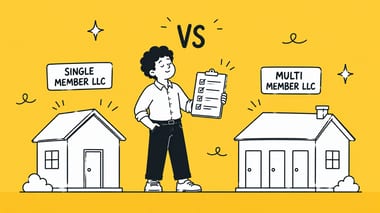
The main difference is the number of owners. A single member LLC has one owner. A multi member LLC has two or more. This one change affects tax, paperwork, and how decisions are made.
| Feature | Multi Member LLC | Single Member LLC |
| Owners | Two or more members | One member |
| Default US tax treatment | Partnership | Disregarded entity |
| Main IRS return | Form 1065 and Schedule K-1 | Form 5472 with pro forma Form 1120 (foreign-owned) |
| Operating agreement | Strongly needed | Recommended |
| Decision making | Shared, based on votes | Owner decides alone |
| Profit sharing | Set by the agreement | Owner keeps all profit |
| Paperwork | More complex | Simpler |
| Risk of owner disputes | Higher | None |
For foreign owners, the filing rules are different for each type. A foreign-owned single member LLC must file Form 5472 every year, even with no income. A multi member LLC taxed as a partnership usually does not file Form 5472, but it may need to file Form 1065 and other partnership forms.
If you run the business alone, a single member LLC is simpler. If you have partners, a multi member LLC is the right choice.
Related articles: If you’re deciding between the two structures directly, our single member vs multi member LLC comparison guide lays out the choice side by side.
Multi Member LLC vs Other Business Structures
A multi member LLC is not the only way to run a business with partners. Here is how it compares to the other common options:
- General partnership: Easy to start, but partners are personally responsible for business debts. A multi member LLC gives you liability protection.
- C-Corp: Taxed as a separate company, and profit can be taxed again when paid out as dividends. It suits businesses that want outside investors. It also has more rules and costs.
- S-Corp: Has pass-through tax, but US law limits S-Corp owners to US citizens and residents. Foreign owners usually cannot use it.
- Sri Lankan private limited company: Registered locally and taxed under Sri Lankan law. It suits businesses that serve local customers, but it does not give you easy access to US payment tools.
For Sri Lankan partners who sell to global clients, a multi member LLC is usually the simplest choice.
Pros and Cons of a Foreign-Owned Multi Member LLC
A multi member LLC gives Sri Lankan partners a lot of flexibility, but it also adds some extra work. Here is a quick look at both sides:
| Pros | Cons |
| Personal assets are protected from business debts | Partners can disagree, and exits can get messy |
| Access to Stripe, US banks, and USD payments | Partnership tax filings are more complex |
| Flexible ownership and profit sharing | A written operating agreement is needed |
| No federal income tax at the LLC level by default | Foreign partners may face US withholding tax |
| No US citizenship or residency needed to own one | Annual state fees and registered agent costs |
| Looks credible to US and global clients | Banking can be harder without an SSN or US address |
| Easy to add or remove members | Sri Lanka tax and exchange control rules still apply |
| Less paperwork than a corporation | Liability protection is not complete (fraud, personal guarantees) |
In short, the structure works well for partners who plan ahead. Most problems come from missing filings or having no clear agreement between members.
Which State Is Best for a Foreign-Owned Multi Member LLC?
For most Sri Lankan owners, Wyoming is the best choice. It has low fees, no state income tax, and does not list member names in public records. New Mexico is the cheapest option, since it has no annual report or annual fee. Delaware is well known and has strong business law, but it costs more each year. It is mainly useful if you plan to raise money from US investors.
The state you pick does not change your US federal tax duties. If you sell online to global clients and have no staff or office in the US, your LLC state matters mostly for fees and privacy.
| Feature | Wyoming | New Mexico | Delaware |
| Formation fee | About $100 | About $50 | About $110 |
| Annual report | Yes, minimum $60 license tax | None | Yes, $300 annual tax |
| Member names public | No | No | No |
| State income tax on LLC | None | Possible if you operate there | None for out-of-state income |
| Best for | Most foreign owners | Lowest yearly cost | Investor-backed businesses |
Important Note: These fees can change with time, so check each state’s official website before you file.
Wyoming suits most multi member setups, but for the full state-by-state breakdown, our US LLC cost guide for non-residentscompares what each one costs to run.
How to Form a Multi Member LLC From Sri Lanka (Step by Step)
You can complete the whole process online. Here are the steps:
- Choose a state and a business name. Pick a state (Wyoming is a common choice). The name must be unique in that state and include “LLC”.
- Appoint a registered agent. This is a person or company with a physical address in your state. They receive legal and tax mail for the LLC. Most foreign owners hire a registered agent service, which costs about $50 to $150 a year.
- File the Articles of Organization. Submit this form to the state’s Secretary of State, online or by mail. You will pay a filing fee. Once approved, you receive a certificate showing the LLC exists.
- Write the operating agreement. All members should sign it. It covers ownership shares, voting, profit sharing, and what happens if a member leaves. Keep a copy for your records.
- Get an EIN. Apply to the IRS using Form SS-4. Foreign owners without an SSN usually apply by fax or mail, or through a formation service. Processing can take a few weeks.
- Open a US business bank account. Online banks such as Mercury, Relay, and Wise Business accept foreign-owned LLCs. You will need your LLC documents, EIN, and passport.
- Set up payment tools. Once the bank account is ready, connect Stripe, PayPal, or other platforms to receive payments.
Many founders use a formation service to handle steps 2 to 5 and save time.
Things You Need to Know About Operating Agreement for a Multi Member LLC
An operating agreement is a written contract between the members of an LLC. You do not file it with the state, but you should always have one. Many states do not require it, yet banks, payment platforms, and the IRS may ask to see it.
Without one, your state’s default rules apply, and they may not match what you and your partners want. For a foreign-owned LLC with members in different places, a clear agreement helps prevent disputes later.
A good operating agreement should cover:
- Ownership percentages: Who owns what share of the LLC.
- Capital contributions: How much money or work each member puts in.
- Voting rights: Which decisions need a simple majority and which need everyone to agree.
- Profit and loss sharing: How and when members get paid.
- Management style: Member-managed or manager-managed.
- Adding new members: The rules for bringing in a new partner.
- Member exit: What happens if someone leaves, sells their share, or passes away.
- Dispute resolution: How you will handle deadlocks or conflicts.
- Closing the LLC: How assets are divided if the business ends.
All members should sign it, and each should keep a copy. Update it whenever ownership or roles change.
Member-Managed vs Manager-Managed LLC
An LLC can be run in two ways, and you choose one when you form it.
- Member-managed: All members take part in daily decisions and can sign contracts for the LLC. This is the default in most states. It works well when every partner is active in the business.
- Manager-managed: The members choose one or more managers to run the business. A manager can be a member or an outsider. Other members stay passive and do not make daily decisions. This suits LLCs where some partners only invest money.
For Sri Lankan partners who live in different countries, a manager-managed setup can be easier. One person can sign bank forms and contracts without needing every member’s approval each time. If all partners work in the business equally, member-managed is simpler.
Whichever you pick, write it clearly in the operating agreement.
How a Foreign-Owned Multi Member LLC Is Taxed in the US
By default, the IRS taxes a multi member LLC as a partnership. The LLC does not pay federal income tax itself. Profit passes to the members, and each member is taxed on their share.
For foreign members, the key question is where the income comes from. Non-US residents are generally taxed in the US only on US-source income. If Sri Lankan partners do the work from Sri Lanka and serve clients abroad, their income is often foreign-source and not taxed in the US. This depends on the facts, so confirm it with a tax professional.
Two types of US income matter most:
- Effectively connected income (ECI): Income from a US trade or business, such as having US staff or an office. It is taxed at regular US rates.
- US-source passive income: Items like dividends and interest usually face a 30% withholding tax, unless a treaty lowers the rate.
If the LLC has ECI, it must withhold tax for its foreign partners and report it to the IRS.
An LLC can also elect to be taxed as a C-Corp using Form 8832. S-Corp status is not available to non-resident owners.
IRS Forms and Deadlines for Foreign Owners
A foreign-owned multi member LLC taxed as a partnership files fewer forms than a single member LLC. The main one is Form 1065, which reports the LLC’s income and expenses. The LLC also gives each member a Schedule K-1 showing their share. If the LLC has no income, deductions, or credits, it generally does not need to file Form 1065.
If the LLC has US-source income that is effectively connected to a US business, it must also file Form 8804 and give each foreign partner Form 8805. These report the tax withheld.
Here, form 5472 with a pro forma Form 1120 applies only if the LLC elects to be taxed as a C-Corp and a foreign member owns 25% or more.
Most deadlines for calendar-year LLCs fall in spring, and an extension is available using Form 7004. Late filing can lead to heavy penalties, so mark these dates early.
| Form | Who Files | Deadline |
| Form SS-4 | LLC, to get an EIN | Before banking or filing taxes |
| Form 1065 and Schedule K-1 | LLC taxed as a partnership with income or deductions | March 15 (extension to September 15) |
| Form 8804 and 8805 | LLC with US-source income and foreign partners | March 15 |
| Form 8832 | LLC choosing to be taxed as a C-Corp | Within 75 days of the effective date |
| Form 5472 and pro forma Form 1120 | LLC taxed as a C-Corp with 25% or more foreign ownership | April 15 (extension to October 15) |
Tax Rules in Sri Lanka for LLC Owners
A US LLC does not remove your Sri Lankan tax duties. If you live in Sri Lanka, you are generally a tax resident and may owe tax in Sri Lanka on your share of the LLC’s profit, even when the money stays in your US account. Sri Lanka’s tax year runs from April 1 to March 31, and you file with the Inland Revenue Department (IRD).
Some points to check:
- Registration: Register with the IRD to get a Taxpayer Identification Number (TIN).
- Foreign income: Income from services sold to overseas clients may qualify for a lower rate or an exemption if the money is brought in through a licensed bank. Confirm the current rules.
- Double tax: If you pay tax in both countries, check whether Sri Lanka allows a credit for US tax paid.
- Exchange control: Rules from the Central Bank of Sri Lanka (CBSL) may apply to owning a foreign company and keeping money abroad.
Important Note: Speak to a Sri Lankan tax advisor before you start. Ask how your LLC profit will be taxed, whether your income qualifies for a lower rate, and if CBSL approval is needed to own a foreign company.
How Multi Member LLC Owners Get Paid
Members do not get a regular salary by default. An LLC taxed as a partnership pays its owners in a few set ways, and the operating agreement should say which ones you use.
- Distributions: This is the most common way. The LLC pays out profit to members, usually based on ownership share. A member with 40% ownership gets 40% of the distribution, unless the agreement says otherwise. Distributions are not a business expense for the LLC.
- Guaranteed payments: A fixed payment to a member for work done or capital invested, paid whether or not the LLC makes a profit. The LLC can deduct it, and the member reports it as income.
- Salary: Members of an LLC taxed as a partnership are generally not treated as employees, so a regular salary is uncommon. Pay is usually made through guaranteed payments instead.
- Expense reimbursement: The LLC can repay members for business costs they paid personally, if they keep receipts.
Tax Point to Remember:You are taxed on your share of the profit each year, even if the LLC does not pay it out to you. A bank transfer is not the same as a tax event.
Sending Money to Sri Lanka
Once the LLC pays you, you can move the money home in a few ways:
- Wise Business: Low fees and the mid-market exchange rate.
- Payoneer: Common with freelancers and marketplace sellers.
- Bank wire: Works, but fees and rates are usually higher.
Keep records of every payment, including the amount, date, and reason. Bring the funds in through a licensed bank so you have a clear paper trail for Sri Lankan tax and exchange control rules.
Yearly Compliance Checklist
A foreign-owned multi member LLC has a few tasks every year. Missing them can lead to fines, a lost good standing, or even closure of the LLC. Use this checklist to stay on track.
| Task | When | Why It Matters |
| File the state annual report and pay the fee | Due date set by your state | Keeps the LLC in good standing |
| Renew your registered agent | Every year | The state needs a valid agent on file |
| File Form 1065 and send K-1s to members | March 15, or September 15 with extension | Reports income and each member’s share |
| File Forms 8804 and 8805, if you have US-source income | March 15 | Reports tax withheld for foreign partners |
| Check Form 5472 rules if you chose C-Corp tax | April 15, or October 15 with extension | Avoids a penalty of $25,000 or more |
| Review and update the operating agreement | When members or roles change | Keeps records accurate |
| Keep LLC and personal money separate | All year | Protects your liability shield |
| Save bank statements, invoices, and K-1s | All year | Needed for US and Sri Lankan tax filings |
| File your Sri Lankan income tax return | Per IRD deadlines | Reports your share of LLC income |
This checklist covers the LLC’s own filings; for the full federal and state calendar in one place, see our LLC tax deadline guide for 2026 and 2027.
Tip:Set calendar reminders 30 days before each deadline. Check whether the Corporate Transparency Act beneficial ownership report applies to you, since the rules have changed recently.
How Much Does It Cost?
Setting up a multi member LLC is cheap. The yearly costs are where most owners are surprised, mainly accountant fees. These figures are estimates, so check current prices before you buy.
| Cost | Estimated Amount | Type |
| State filing fee | $50 to $110 | One-time |
| Registered agent | $50 to $200 | Yearly |
| State annual fee or report | $0 to $300 | Yearly |
| Operating agreement (template or lawyer) | $0 to $500 | One-time |
| EIN | Free from the IRS | One-time |
| Formation service (optional) | $100 to $500 | One-time |
| Accountant for Form 1065 and K-1s | $500 to $1,500 | Yearly |
| Business bank account | Often $0 | Monthly or yearly |
Rough total: Expect about $300 to $1,000 to get started and $700 to $2,000 per year to stay compliant. Wyoming and New Mexico are usually at the lower end. Delaware costs more.
Common Mistakes Foreign Owners Make
Most problems with a multi member LLC come from small things that were skipped early. Avoid these:
- No operating agreement: Without one, state default rules apply and partners can end up in a dispute. Write and sign it before you start.
- Mixing personal and business money: Paying personal bills from the LLC account can weaken your liability protection and make tax records messy.
- Missing IRS filings: Late or missed forms can lead to heavy penalties. Even a no-income year may need a filing, depending on your setup.
- Ignoring US withholding rules: If the LLC has US-source income, it may need to withhold tax for foreign partners.
- Picking a state by price alone: Check annual fees, privacy, and reporting rules, not just the filing fee.
- Forgetting Sri Lankan tax and CBSL rules: A US LLC does not cancel your duties at home.
- Skipping the annual report or registered agent renewal: The state can suspend your LLC for missing these.
- Not keeping records: Save invoices, bank statements, and K-1s every year.
- Doing it all without help: A small accountant fee costs far less than a penalty.
When to Hire a Professional?
You can form a multi member LLC on your own. But a missed filing or a weak operating agreement can cost far more than the help would have. It is smart to get support if:
- Your partners live in different countries.
- You expect US-source income or US customers.
- You are not sure how Sri Lankan tax rules apply to your share of the profit.
- You want your EIN, bank account, and Stripe set up without delays.
- You do not want to track yearly filings and deadlines yourself.
At BR.LK, we help Sri Lankan founders form their US LLC remotely, usually within 24 to 48 hours. We also handle your registered agent, EIN, BOI report, annual reports, US bank account setup, Stripe setup, and bookkeeping. Our Sinhala and Tamil speaking team will walk you through each step, so you start with the right structure and stay compliant.
Ready to start your multi member LLC? Contact us or book a free meeting, and we will plan the right setup for you and your partners.
Conclusion
A foreign-owned multi member LLC is a practical way for Sri Lankan partners to do business with global clients. It protects your personal assets, gives you access to Stripe and US banking, and lets you split ownership and profit the way you want.
The setup is only the first step. You need a signed operating agreement, the right IRS filings each year, and a clear plan for Sri Lankan tax and exchange control rules. Pick your state with care, keep your records clean, and track every deadline.
If you plan ahead and get expert help where needed, a multi member LLC can grow with your business for years.
Key Takeaways
- A multi member LLC is a US company with two or more owners, and Sri Lankans can form one without US residency or an SSN.
- The LLC protects your personal assets from business debts, though the protection is not complete.
- By default, the IRS taxes a multi member LLC as a partnership, so profit passes to the members.
- Wyoming is the most common state for foreign owners because of its low fees, no state income tax, and private member names.
- A signed operating agreement should cover ownership, voting, profit sharing, and what happens when a member leaves.
- Foreign owners are generally taxed in the US only on US-source income, but this depends on the facts of your business.
- The main IRS forms are Form 1065 and Schedule K-1, and Forms 8804 and 8805 apply if the LLC has US-source income.
- A US LLC does not remove your Sri Lankan tax duties, so you may still owe tax in Sri Lanka on your share of the profit.
- Plan for about $300 to $1,000 to start and $700 to $2,000 each year to stay compliant.
- Missing filings, mixing personal and business money, and skipping the operating agreement are the most common mistakes.
FAQs
Yes. Your operating agreement sets the rules for adding or removing members, including the votes needed, share transfers, and buyouts. Update the agreement whenever ownership changes. You may also need to update state records and your tax filings, so tell your accountant and registered agent about the change.
Yes. Online banks such as Mercury, Relay, and Wise Business accept foreign-owned LLCs, and you can apply remotely. You will need your LLC documents, EIN, and passport. Traditional US banks often want you to visit in person, so most Sri Lankan owners choose online banks.